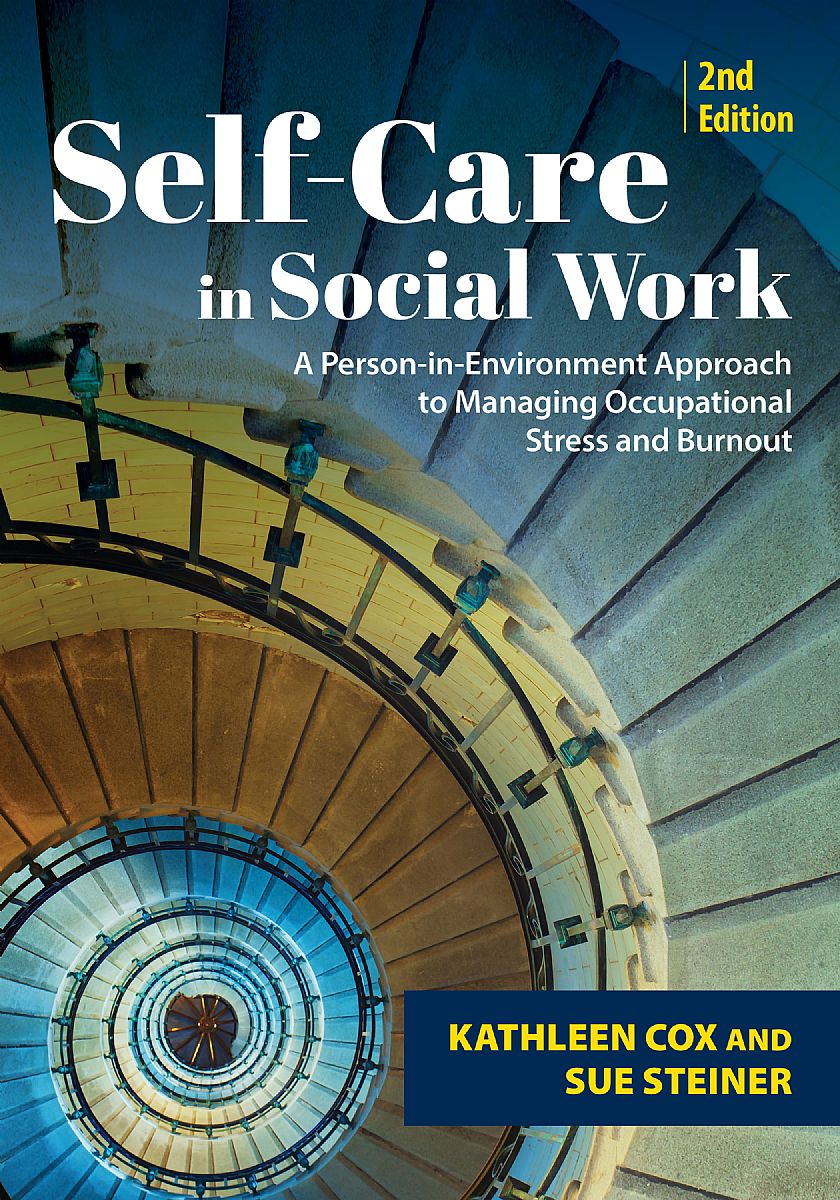
Self-Care in Social Work, 2nd Edition
A Person-in-Environment Approach to Managing Occupational Stress and Burnout
Authors: Kathleen Cox and Sue Steiner
Page Count: 208
ISBN: 978-0-87101-601-0
Published: 2024
Item Number: 6010
eBook$39.12Paperback$40.33
NASW members receive 10% discount on books and eBooks by entering their membership number at checkout.
Can your device download this eBook? Click here before purchasing! eBooks are available in single quantities only.
Earn 6.5 CEUs for reading this title! For more information, visit the Social Work Online CE Institute.
Going beyond clichéd self-help advice, Self-Care in Social Work applies a cognitive coping framework to social work activities to support practitioners in preventing or reducing burnout, secondary trauma, and vicarious trauma. This framework is woven into chapters devoted to self-awareness, self-regulation, and self-efficacy, applying social work skills to the practitioners themselves. Further, the authors posit that it is the responsibility of supervisors and organizations to ensure social workers’ well-being and emotional safety. Whereas most self-care strategies encourage individuals to engage in activities that enhance their health and well-being, such as exercising, eating well, sleeping more, getting massages, meditating, or taking bubble baths, this book also recognizes the importance of the person-in-environment framework in shifting our thinking about self-care.
Now in its second edition, Self-Care in Social Work includes current research on the impact of stress, burnout, secondary trauma, and vicarious trauma. Self-compassion is presented as a tool for self-regulation, alongside material on cognitive reframes, mindfulness, and balanced use of empathy. Finally, this edition features a new chapter focused on traumatic stress related to racism and oppression, with contributions from experts on culturally relevant approaches to self-care. For social workers, counselors, and mental health professionals who struggle with exhaustion and are at risk for burnout, Self-Care in Social Work provides insight, inspiration, and hope.
About the Authors
Acknowledgments
Editorial Note
Preface
Introduction
Part 1: Understanding Stress and Self-Care
Chapter 1: Making Sense of Stress
Chapter 2: Self-Care as a Solution
Chapter 3: Culturally Relevant Self-Care
Written with Kelechi Ubozoh, Ari Acosta, Pata Suyemoto, and Josh Kinchen
Part 2: Personal Strategies for Self-Care
Chapter 4: Self-Awareness
Chapter 5: Self-Regulation
Chapter 6: Self-Efficacy
Part 3: Organizational Strategies for Self-Care
Chapter 7: Understanding Organizations and Our Fit within Them
Written with Bob Steiner
Chapter 8: Social Work Supervision
Chapter 9: Workplace Wellness
Final Thoughts
References
Index
Earn 6.5 CEUs for reading this title! For more information, visit the Social Work Online CE Institute.
Self-Care in Social Work: A Person-in-Environment Approach to Managing Occupational Stress and Burnout, 2nd Edition, was reviewed by Amy R. Manning for the journal Health & Social Work.
Self-Care in Social Work by Cox and Steiner is written in an educational, self-help style, offering readers compassion and rest in a field that is focused on helping others, often at the expense of the helper. Written for an audience of both new and experienced social workers, Cox and Steiner present a well-developed discussion of stress and stress responses using real-world examples that highlight both structural issues in the field of social work and the realities of being in a helping profession. Across the chapters, the authors explore the mythical “work/life balance” with a critical lens focused on choices that a social worker can make in an effort to provide themselves with a solid self-care routine to prevent, or even address and heal from, burnout.
Self-Care in Social Work makes a compelling addition for the book collection of a social worker. In addition to using this book for personal reflection and growth, the content makes an excellent guide for social work faculty and supervisors to use when working with their students and employees. The perspective offered throughout the book is one of purpose and hope. A person in the midst of burnout could realistically apply the concepts in this book without investing significant energy in the process, and in turn, rebuild their capacity both personally and professionally.
Read the full review. Available to subscribers of Health & Social Work.
Our study of self-care started with a desire to support our undergraduate and graduate students in social work who lamented the lack of time for self-care and a limited understanding of what is really meant by the term. We had heard comments, such as: “You guys are always telling us that self-care is important, but you load us up with so much work that we have no time for it! What is self-care anyway?” Such questions and concerns sparked our interest in developing a thorough understanding of self-care and the ways in which it can be embedded in all that we do as social workers. We were of the opinion that it should not be an afterthought or an add-on to other more important responsibilities.
To learn more, we went to the experts: workers in the human services field who have insight into not only the stress of social work but also what constitutes effective workplace coping. We recruited more than 60 of them to participate in workshops and focus groups to explore this issue in depth. In addition, we asked colleagues and students to send us stories that reflect their experiences with various workplace challenges and reviewed the literature across disciplines that address biological, psychological, social, cultural, spiritual, and organizational aspects of stress and coping.
Since our first edition, the concept of “self-care” has been popularized. We are aware that the term sometimes rubs social workers the wrong way because they equate it with an unattainable prescription to manage stress in the midst of unmanageable workloads and chaotic work environments. We hope that they will find value in our macro material that promotes supervisory and administrative initiatives to support the self-care of employees. We also have observed the evolving landscape of self-care activities as individuals embrace the use of smartphones and social media. Our new edition recognizes the value in these tools as well as the challenges associated with excessive social media consumption.
As our study has progressed, we have come to appreciate the importance of understanding the meaning of self-care from diverse perspectives. We are proud of the new chapter in this second edition that focuses on race-based traumatic stress and radical/decolonized self-care. Moreover, we are excited to share the essays of contributing authors that discuss self-care specific to the Black/African American, Hispanic/Latinx, LGBTQ+, and Asian communities.
Many social workers enter the profession because they have a desire to help others in need and to contribute to the betterment of society. They are drawn to a line of work wherein they can assist individuals, groups, families, and communities to surmount the hardships and challenges that life brings. New to their craft, these budding professionals are fully prepared to use their hard-earned knowledge and to hone their skills to attain the rewards that are promised by a people-oriented practice. What comes as a surprise to some, however, is the huge toll that the work takes on social workers’ emotional well-being, physical health, and interpersonal functioning over the course of their careers. In the worst cases, this toll can result in shortened careers.
Leaders in the field of social work have been calling attention to the sometimes serious consequences of work-related stress on individuals and the systems in which they are employed. In her recent article “Workplace Care for Social Worker Stress,” Rine (2023) argued that stress poses a serious threat to the personal and professional wellness of social workers. The literature over the past several decades has explored a range of stress-related conditions that plague professional helpers. Figley (1995) coined the term compassion fatigue in referring to a set of physical and psychological symptoms appearing in social workers who are exposed to client suffering that occurs as a result of traumatizing events, such as physical or sexual abuse, combat, domestic violence, or the suicide or unexpected death of a loved one. Psychological symptoms of this type of secondary traumatic stress (STS) include depression, anxiety, fear, rage, shame, emotional numbing, cynicism, suspiciousness, poor self-esteem, and intrusive thoughts or avoidance of reminders about client trauma. Physiological symptoms, including hypertension, sleep disruption, and immune system malfunctions, have been found to result in serious illness and a relatively high mortality rate in helping professionals (Beaton & Murphy, 1995). Similarly, burnout has been defined as a process involving gradually increasing emotional exhaustion in workers along with a negative attitude toward clients and a reduced commitment to the profession (Maslach, 1993). It is thought to be associated with a work environment that makes high demands on employees but offers limited supports and rewards. Both worker burnout and STS have been implicated in high rates of turnover in social work organizations (Pryce et al., 2007). Another occupational hazard in the field of social work is referred to as vicarious traumatization, a transformation of the professional helper’s worldview as a result of “empathic engagement with survivor clients and their trauma material” (Saakvitne et al., 1996, p. 17). Because social workers are routinely exposed to client suffering and trauma, they may be vulnerable to shifts in their fundamental assumptions concerning safety, trust, control, and benevolence in the world.
In response to these threats to the stability of social workers and the human services agencies in which they are employed, administrators may offer training seminars that provide education on the signs and symptoms of STS. Coursework on this topic is also increasingly common in university curricula at both the undergraduate and graduate levels. These advances have built awareness of psychological risks in the profession, but they have offered limited assistance to social work interns and practitioners who are striving to resolve work-related distress and trauma. Training participants are often encouraged to practice “self-care,” yet they are provided limited guidance in conceptualizing this crucial process that promises both self-preservation and professional goal attainment. Moreover, suggestions offered for promoting personal care are often found to be of minimal use or effectiveness. For instance, workers under mounting stress might be advised to “take breaks” from case-related or administrative tasks during their assigned shifts. After doing so, they might find that they are farther behind and feeling buried under unfulfilled duties and unmet expectations. Or distressed workers attempting to follow the recommendation to relax at home might find that instead of “leaving work behind,” they are ruminating about mistakes made on the job and unaddressed client needs. They may also be checking email from home, noting what is not getting done, and thus increasing their stress. Even more discouraging, the employee who accesses a therapist from their agency’s employee assistance program may discover that the clinician has no understanding of these particular work-related issues.
This book offers an alternative to social work practitioners and interns seeking to understand the essential elements of self-care. It suggests a new way of thinking about how they can help themselves to function optimally on the job. In conceptualizing the process of self-care, we emphasize the importance of the three Ss: self-awareness, self-regulation, and self-efficacy. In addition to this microsystem focus on personal strategies for self-care, we incorporate a macrosystem perspective that recognizes organizational sources of stress and constructive coping. Because of this wide frame of reference, the intended audience of this book is quite broad and includes social work students, practitioners, supervisors, and administrators. In addition to serving as a guide for practicing social workers, this book is structured so that it may be used as a text for undergraduate and graduate social work practice and practicum courses as well as courses dedicated to understanding and reducing stress and improving self-care.
In presenting our views of self-care, we draw from the literature, statements made by participants in workshops and focus groups, and stories submitted by students and social workers about their experiences with work-related stress and strategies for coping. To facilitate the integration of the material presented, we provide activities and examples, discussion questions, and chapter exercises. We encourage readers to take time to read the “From the Field” stories and to carefully consider the questions posed in the sections titled “Reader Reflections.” Discussion questions and exercises at the end of each chapter can be used in classes or workshop training sessions to help students and workers delve more deeply into the concepts discussed.
Part 1 of this book is aimed at conceptualizing the stress and coping process. Chapter 1 examines the effects of stress on our physiological, emotional, and behavioral functioning. It also highlights the importance of recognizing both personal and organizational sources of stress. Consistent with this dual focus, we assert that responsibility for the management of workplace stress lies both with the individual employee and the agency’s management team or administration. Chapter 2 focuses on the ways in which the concept of self-care has evolved in recent years. We describe various commonly proposed strategies for self-care, including those falling into the general categories of lifestyle or workplace adjustments. Chapter 3 covers culturally relevant approaches to self-care. It begins with a discussion of race-based traumatic stress and then reviews radical and decolonized approaches to self-care. Essays by contributing authors are included that address self-care from the perspective of Black/African American, Asian American, LGBTQ+, and Hispanic/Latinx cultural groups.
Part 2 of the book delves into the three Ss: self-awareness, self-regulation, and self-efficacy. Chapter 4 seeks to help readers become more aware of signs of stress, emotional reactions, and thinking patterns as they relate to social work. Emphasis is placed on situational meaning that may be derived from work-related experiences, including thoughts concerning client, self, and system limitations. Chapter 5 is devoted to assisting social workers striving to regulate their emotions in response to clients who are needy, demanding, hostile, or distraught. The cognitive reframe is introduced as a valuable tool that reorients our perceptions of problematic events so that they are seen in a more positive light. In addition, the practice of mindfulness is discussed as a method of self-soothing for workers who are fatigued or “soul sick” as a result of empathic engagement with clients. This chapter also covers self-compassion and stresses the value of balance in the helping professions. It references an ancient Hindu myth (“Shiva’s Circle”) to illustrate the importance of balance between empathy toward others and a need to stand apart from their pain. Chapter 6 highlights threats to self-efficacy that are common in social work when client progress is painfully slow or nonexistent. It offers strategies for maintaining self-confidence and a sense of competence amid client resistance to change and slow systems change. For instance, we encourage workers to notice and celebrate small steps toward client success and system transformation. We also emphasize the importance of adapting case-based and professional goals so that they are realistic and achievable.
Part 3 of the book focuses on organizational issues as they relate to self-care. Chapter 7 aids readers in assessing their level of fit with their organization’s culture as it concerns hierarchy, individualism, importance of relationships, directness of communication, time perspective, and information processing. It also suggests practical steps that can be taken to improve congruence between the individual’s approach to managing work-related responsibilities and those favored by their organization. Chapter 8 stresses the importance of high-quality supervision in supporting the self-care of workers and in counteracting contagion, that is, the spread of traumatic stress in the agency. It also addresses stressors commonly experienced by supervisors. Chapter 9 identifies structural steps that social work agencies can take to reduce employee stress and promote inclusion, equity, and workplace wellness. In that chapter, we make a case for the devotion of organizational resources to the self-care of human services workers. We show how doing so results in benefits for both individual employees and the organization as a whole. Furthermore, we maintain that the future of the social work profession depends on the maintenance of a vibrant, healthy, and well-functioning workforce.