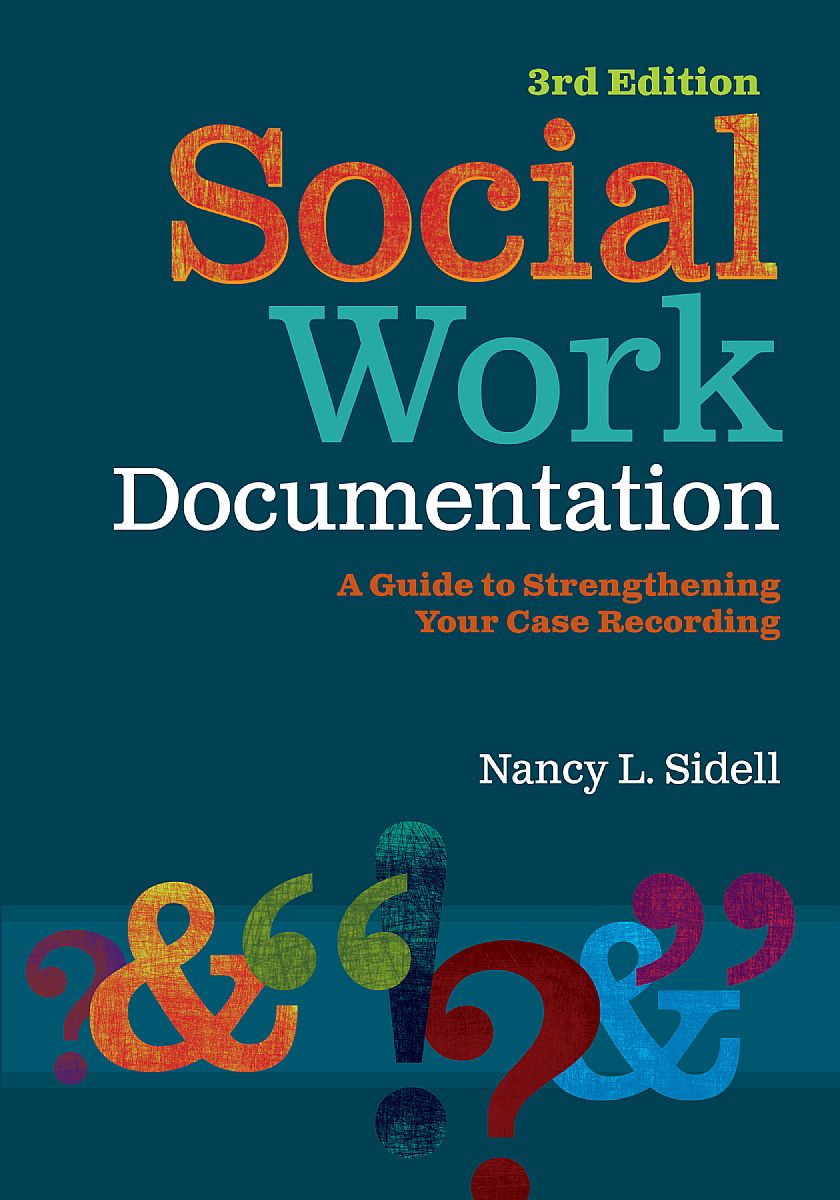
Social Work Documentation, 3rd Edition
A Guide to Strengthening Your Case Recording
Author: Nancy L. Sidell
Page Count: 276
ISBN: 978-0-87101-592-1
Published: 2024
Item Number: 5921
eBook$39.25Paperback$46.18
NASW members receive 10% discount on books and eBooks by entering their membership number at checkout.
Can your device download this eBook? Click here before purchasing! eBooks are available in single quantities only.
Earn 8.0 CEUs for reading this title! For more information, visit the Social Work Online CE Institute.
Despite so much time spent documenting, social workers often have a negative response to documentation—it is the bane of many professionals’ existence. To many social workers, documentation means responding to unnecessary bureaucratic demands and tending to tedious and boring details instead of spending time on their true passion: working with clients. Overworked social workers do not appreciate the requirement for case recording and often delay the task. The phrase “if it’s not documented, it’s not done” is commonly used to encourage better documentation habits, but the particulars of how to do so are less well noted.
Designed to help practitioners build writing skills in a variety of settings, Social Work Documentation is a how-to guide for social work students and practitioners interested in improving their record keeping and documentation skills. This wildly popular, must-have resource provides practical advice on current practice issues such as electronic case recording, trauma-informed documentation, and assessing and documenting client cultural differences of relevance.
The third edition has been updated to view documentation through person-first language, and includes a new chapter on bias-free language selection, with examples and exercises to ensure appropriate wording choices are used related to age, disability, immigration and socioeconomic status, and gender and sexual orientation.
Over 120 exercises throughout the book build skills through application and practice. Designed to elicit written answers, the exercises can be completed individually or with a colleague, supervisor, or fellow student. Peer learners can work through the exercises and provide one another with helpful feedback. A supervisor can provide specific and constructive feedback to promote more polished and professional recording abilities. In all cases, the skills learned will greatly enhance a social worker’s professionalism and ultimately result in better service to clients.
About the Author
Acknowledgments
About This Book
Part I: Understanding Documentation
Chapter 1: Introduction to Social Work Documentation
Chapter 2: Documentation Today
Chapter 3: Laying the Foundation
Chapter 4: Special Issues in Documentation
Chapter 5: Language Selection Matters
PART II: Sections of a Case Record
Chapter 6: Information Summary Sheets
Chapter 7: Confidentiality, Release Forms, and Informed Consent Forms
Chapter 8: Assessments and Treatment Plans
Chapter 9: Documenting Client Progress
Chapter 10: Communication with and about Clients
PART III: Beyond the Basics
Chapter 11: Getting and Giving Feedback
Chapter 12: Supervision and Documentation
Chapter 13: The Future of Documentation
References
Index
Earn 8.0 CEUs for reading this title! For more information, visit the Social Work Online CE Institute.
The purpose of this book is to provide practical, hands-on experience to social workers wishing to improve their documentation skills. It stems from concerns about the wearing away of basic writing skills, hastened by a reduced emphasis on grammar and spelling at all levels of education and a devaluation of the written word. One example of this erosion is the appearance in formal kinds of writing of shorthand abbreviations, previously acceptable only in informal electronic communications.
Social workers must document the services they provide, regardless of their educational level or the setting in which they are employed. Many are unprepared for this responsibility. Social work programs teach skills necessary for effective social work practice but often leave instruction about professional documentation to agency field instructors. Social workers should arrive at the workplace well prepared to document, but often they do not, and most agencies hiring new social workers must train them on the job.
Undergraduate and graduate students, as well as seasoned social workers, can benefit from instruction in the basics of social work documentation. This book is written with the goal of improving social workers’ writing skills and better preparing them for the written demands of their work. It can be useful as a reference tool in agency settings in which employees need assistance with documentation concepts.
This book reviews common formats and examples. It cannot, however, cover all of the documentation requirements that social workers may find during their careers or all of the settings in which social workers practice. The term “agency” is most commonly used to refer to the workplace throughout this book for efficiency purposes and in no way conveys the richness of the numerous settings in which social workers are employed. Neither does this book replace specific agency guidelines or jurisdictional rulings. Not all examples will be useful in every setting, given the wide variation in documentation requirements. Although this book cannot replace agency policy documents or supervisory guidance, it can serve as a learning tool.
The book is divided into three sections. The first five chapters give a general overview of documentation—its history, considerations that need to be addressed before documentation begins, special issues, and the importance of language. The second portion of the book reviews in turn the different components of a typical record. The last section focuses on ways in which documentation can be evaluated
and improved. Continuous skill improvement and supervisory issues are covered here, along with a look at future trends and directions. Over 130 exercises are found throughout the book, designed to build confidence about and knowledge of important aspects of documentation.
The exercises are designed to elicit written answers, which can be kept in a separate notebook or folder. Many of them are best completed with one or more peers who work through the exercises at the same time. Although the term “peer” is used throughout the exercises, a supervisor, fellow student, or colleague can fill this role. For example, a social worker may find that a supervisor’s feedback about the exercises is helpful to their professional growth. Alternatively, working with a peer who is also interested in improving documenting skills may be beneficial. Both social workers can work through the exercises and provide one another with helpful feedback. Specific and constructive feedback from a supervisor or peer can promote more polished and professional recording abilities. These skills will greatly enhance a social worker’s professionalism and ultimately result in better service to clients.