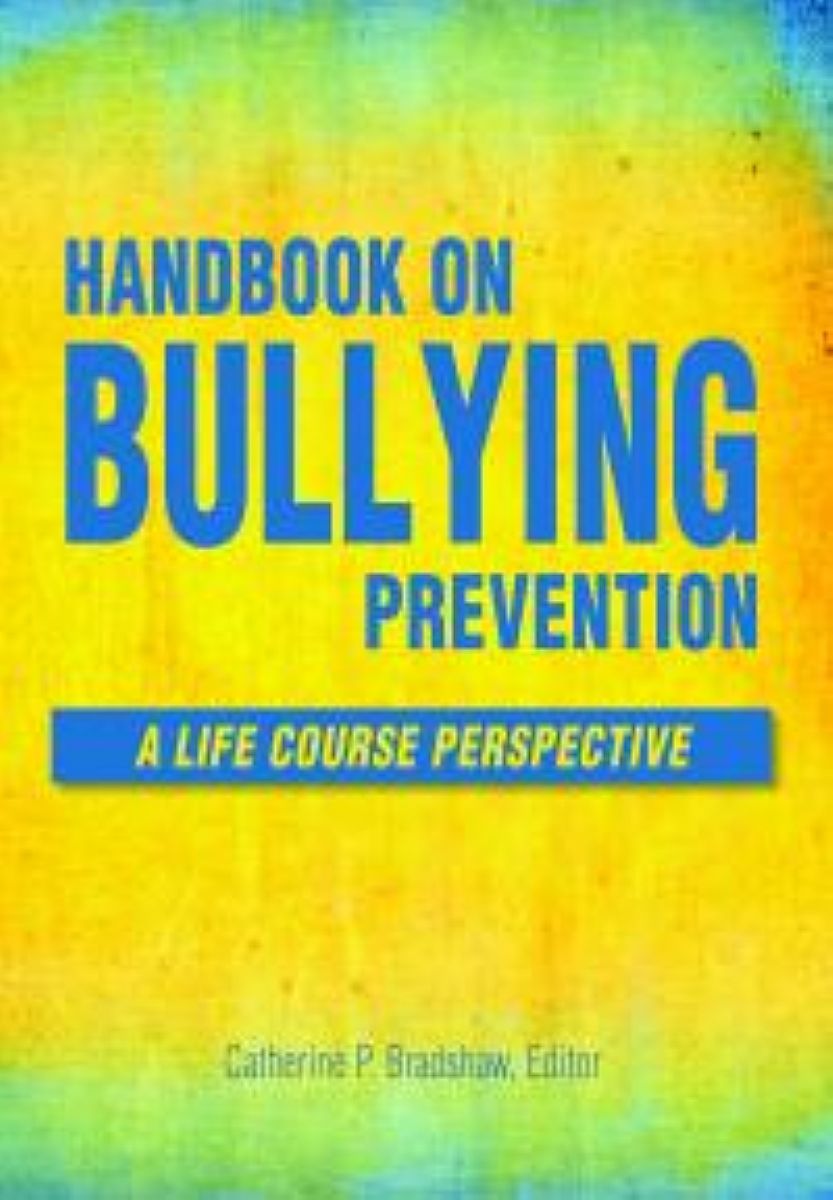
Handbook on Bullying Prevention
A Life Course Perspective
Editor: Catherine P. Bradshaw
Page Count: 296
ISBN: 978-0-87101-500-6
Published: 2017
Item Number: 5006
eBook$33.99Paperback$39.99
NASW members receive 10% discount on books and eBooks by entering their membership number at checkout.
Can your device download this eBook? Click here before purchasing! eBooks are available in single quantities only.
Bullying is a topic that has raised major concern for our nation, so much, that all states have passed policies that specifically address this issue. This problem is very common among youth and adults, and has the potential to have long-term effects. In the Handbook on Bullying Prevention: A Life Course Perspective, chapter authors provide recommendations for prevention and early intervention in bullying situations involving youth and adults across the life course.
There are very few books specifically written about bullying across the life course, and this handbook focuses on understanding causes and consequences, as well as prevention, in several different settings, not just schools. This handbook is intended to serve as a “go-to” resource to bring awareness and provide effective strategies for stemming the harmful impacts of bullying. Handbook on Bullying Prevention is a helpful guide for social workers, mental health clinicians, practitioners, researchers, and educators.
Acknowledgements
About the Editor
About the Contributors
Foreword by James Garbarino
Introduction: A Life Course Perspective on Bullying Prevention
Catherine P. Bradshaw
Part I: Foundational Research on Bullying
Chapter 1: Defining and Measuring Bullying across the Life Course
Jennifer Greif Green, Michael J. Furlong, and Erika D. Felix
Chapter 2: Developmental Roots of Bullying
Jamie M. Ostrov, Sarah J. Blakely-McClure, and Kimberly E. Kamper-DeMarco
Part II: Potential Impacts of Bullying
Chapter 3: The Neurobiology of Peer Victimization: Longitudinal Links to Health, Genetic Risk, and Epigenetic Mechanisms
Tracy Vaillancourt, Carleigh Sanderson, Paul Arnold, and Patricia McDougall
Chapter 4: Relational Bullying and Psychosocial Correlates across the Life Course
Hillary K. Morin and Catherine P. Bradshaw
Chapter 5: Bullying, Mental Health, and Suicide
Jeffrey Duong and Catherine P. Bradshaw
Chapter 6: Cyberbullying: Risk Factors and Consequences across the Life Course
Tracy E. Waasdorp, Zephyr Horowitz-Johnson, and Stephen S. Leff
Part III: Bullying among Youth: Cultural and Contextual Considerations
Chapter 7: Developmental Model of Youth Bullying, Sexual Harassment, and Dating Violence Perpetration
Dorothy L. Espelage
Chapter 8: Bullying among Sexual Minority Youth
Jeffrey Duong and Catherine P. Bradshaw
Chapter 9: Bullying and Cultural Considerations
Joanna Lee Williams and Saida B. Hussain
Chapter 10: Bullying among Youth with Disabilities
Chad A. Rose
Part IV: Bullying among and by Adults
Chapter 11: Bullying and Prevention of Bullying on College Campuses
Elizabeth Bistrong, Hillary K. Morin, and Catherine P. Bradshaw
Chapter 12: Bullying in the Workplace
Catherine P. Bradshaw, Hillary K. Morin, Elizabeth Bistrong, and Katherine Figiel-Miller
Chapter 13: Bullying of Children by Adults: The Undiscussables
Stuart W. Twemlow, Peter Fonagy, and Chloe Campbell
Part V: Approaches to Prevention and Intervention
Chapter 14: The Transactional Association between School Climate and Bullying
Lindsey O’Brennan and Catherine P. Bradshaw
Chapter 15: Integrating Bullying Preventing Efforts through Positive Behavioral Interventions and Supports
Catherine P. Bradshaw
Chapter 16: Lessons Learned from Scaling Up the Olweus Bullying Prevention Program
Susan P. Limber and Dan Olweus
Chapter 17: Prevention and Early Intervention Efforts for Targets of Bullying and Youth Who Bully
Amanda B. Nickerson, Danielle Guttman, and Erin Cook
Chapter 18: Preventing Bullying in Middle Schoolers by Using the Coping Power Program: A Targeted Group Intervention
Catherine P. Bradshaw, John E. Lochman, Nicole Powell, and Nicholas Ialongo
Chapter 19: The Role of Education Support Professionals in Preventing Bullying
Tracy E. Waasdorp, Lindsey O’Brennan, and Catherine P. Bradshaw
Chapter 20: Youth Engagement in Bullying Prevention Efforts: History, Current Applications, and the Born Brave Bus Tour
Susan M. Swearer, Michelle Howell-Smith, Sara E. Gonzalez, Zachary R. Myers, Heather Schwartz, Jenna Strawhun, Theresa McKinney, and Cynthia Germanotta
Chapter 21: Policies Related to the Prevention of Bullying
Anna Heilbrun and Dewey Cornell
Chapter 22: Promoting Relationships to Prevent Bullying: A Network Approach
Wendy Craig, Debra J. Pepler, Joanne Cummings, and Kelly Petrunka
Chapter 23: The Role of Physicians and Other Health Providers in Bullying Prevention
Sarah Lindstrom Johnson, Catherine P. Bradshaw, Tina Cheng, and Joseph Wright
Catherine Bradshaw, PhD, MEd, is a professor and the associate dean for research and faculty development at the Curry School of Education, University of Virginia; she is also the deputy director of the Centers for Disease Control and Prevention (CDC)-funded Johns Hopkins Center for the Prevention of Youth Violence and codirector of the National Institute of Mental Health (NIMH)-funded Johns Hopkins Center for Prevention and Early Intervention. She holds a doctorate in developmental psychology from Cornell University and a master’s of education in counseling and guidance from the University of Georgia. Her research focuses on issues related to bullying and school climate; the development of aggressive and problem behaviors; and the design, evaluation, and implementation of evidence-based prevention programs in schools. She has coauthored over 200 journal articles and book chapters. She has considerable experience leading federally funded randomized trials of school-based prevention programs, including Positive Behavioral Interventions and Supports and social-emotional learning curricula. Her research has been funded by federal grants from the NIMH, National Institute on Drug Abuse, CDC, National Institute of Justice, U.S. Department of Education, and the Institute of Education Sciences, as well as foundation awards from the William T. Grant Foundation and Spencer Foundation. She has also consulted with the National Education Association, National Academy of Sciences, the United Nations, and the World Bank on issues related to bullying, mental health, and school-based prevention. She is a former associate editor for the Journal of Research on Adolescence, the editor of Prevention Science, and coeditor of the Handbook of School Mental Health.
Paul Arnold, MD, PhD, is the inaugural director of the Mathison Centre for Mental Health Research & Education, an associate professor in the Departments of Psychiatry and Medical Genetics, and Alberta Innovates Health Solutions Translational Health Chair in Child and Youth Mental Health at the University of Calgary. His research focuses on the neurobiology of childhood neuropsychiatric disorders and risk and resilience factors in childhood mental health.
Elizabeth Bistrong, MEd, is a doctoral student in clinical psychology at the University of Virginia. Her research focuses on bystander reactions to bullying in middle and high school students.
Sarah J. Blakely-McClure, MA, is a doctoral student in the clinical psychology program at the University at Buffalo, the State University of New York. Her research interests include the development of self-concept and its association with aggressive behavior.
Chloe Campbell, PhD, is senior research fellow on the Psychoanalysis Unit at University College London. She has published widely on school violence, prevention of bullying in schools and the workplace, and innovative methods for managing the school climate.
Tina Cheng, MD, MPH, is the chair of pediatrics at Johns Hopkins Bayview, vice-chair of the Johns Hopkins Department of Pediatrics, and a professor of public health. She received her MD from Brown University and her MPH from the University of California. Her clinical, teaching, and research efforts focus on child health disparities, violence prevention, and primary care models to promote positive youth development and family health.
Erin Cook, MA/AC, NCSP, is completing her doctoral degree at the University at Buffalo, the State University of New York. She is a graduate assistant at the Alberti Center for Bullying Abuse Prevention, and her research interests include bullying among students with disabilities and school crisis prevention and intervention.
Dewey Cornell, PhD, is a forensic clinical psychologist who holds the Bunker Chair in Education at the Curry School of Education, University of Virginia. His research interests include bullying, school climate and safety, threat assessment, and youth violence prevention.
Wendy Craig, PhD, is professor and head of the Department of Psychology at Queen’s University, Kingston, Ontario, Canada. Her research program focuses on healthy relationships, bullying and victimization, and knowledge mobilization.
Joanne Cummings, PhD, is a registered child clinical psychologist in Toronto, Ontario, Canada, and she is the knowledge mobilization director of PREVNet (Promoting Relationships and Eliminating Violence Network). With PREVNet, her work focuses on translating knowledge and brokering partnerships between university researchers and youth-serving organizations, governments, and corporations to promote healthy social development for Canada’s youth.
Jeffrey Duong, PhD, holds a doctorate from the Johns Hopkins Bloomberg School of Public Health and is currently in medical school at the University of California, Davis, School of Medicine. His research focuses on child and adolescent development, with an emphasis on bullying among sexual minority youth.
Dorothy L. Espelage, PhD, is a professor of psychology at the University of Florida in Gainesville. She has conducted research on bullying, homophobic teasing, sexual harassment, and dating violence for the last 22 years.
Erika D. Felix, PhD, is an assistant professor in the Department of Counseling, Clinical, and School Psychology at the University of California, Santa Barbara. She is an expert in promoting adaptive recovery for youth following disasters, youth victimization (including bullying) and its consequences, and research and evaluation to improve community-based services.
Katherine Figiel-Miller, EdM, is a practitioner of educational interventions. She is currently the assistant director of service-learning at Loyola University Maryland.
Peter Fonagy, PhD, is Freud Professor of Psychoanalysis at University College London, with extensive publications on school violence, prevention of bullying in schools and the workplace, and innovative methods for managing the school climate.
Michael J. Furlong, PhD, is a professor at the University of California, Santa Barbara, affiliated with the International Center for School-Based Youth Development. He is a fellow of the American Psychological Association (Division 16, School Psychology) and the American Educational Research Association. His research focuses on youth psychological well-being, assessment of positive psychology self-schemas, resilience, school violence, and bullying.
James Garbarino, PhD, holds the Maude Clark Chair in Humanistic Psychology and is senior faculty fellow at the Center for the Human Rights of Children at Loyola University Chicago. His most recent book is Listening to Killers.
Cynthia Germanotta, MA, is the cofounder and president of Born This Way Foundation, which she founded with her daughter, Lady Gaga, to empower youth and inspire bravery.
Sara E. Gonzalez, MA, is a doctoral student at the University of Nebraska–Lincoln, involved in research on bullying.
Jennifer Greif Green, PhD, is an associate professor of special education in the School of Education at Boston University. Her research focuses on school-based mental health service provision and bullying prevention, with a particular emphasis on survey methods.
Danielle Guttman, PhD, NCSP, is a school psychologist working for the Aldine Independent School District, Houston, Texas. Formerly, she was a postdoctoral research associate at the Alberti Center for Bullying Abuse Prevention at the University at Buffalo, the State University of New York. Her research interests include schoolwide prevention approaches related to social-emotional issues.
Anna Heilbrun, MA, is a doctoral candidate in clinical psychology at the Curry School of Education, University of Virginia. Her research interests include disciplinary practices, school safety, and threat assessment.
Zephyr Horowitz-Johnson is a clinical research assistant at the Children’s Hospital of Philadelphia. Her research interests surround promoting positive school climate in underserved communities.
Michelle Howell-Smith, PhD, is a research assistant professor at the Nebraska Academy for Methodology, Analytics, and Psychometrics.
Saida B. Hussain, PhD, is a graduate of the community psychology doctoral program at the University of Virginia. Her broad research interests include the examination of race-related experiences among marginalized youth and their relationships with supportive adults.
Nicholas Ialongo, PhD, is a professor in the Johns Hopkins Bloomberg School of Public Health, where he has directed a number of large-scale evaluations of elementary schoolbased preventive intervention trails.
Kimberly E. Kamper-DeMarco, PhD, is a postdoctoral associate at the Research Institute on Addictions, University at Buffalo, the State University of New York. Her research interests center on the development of aggression, victimization, and related psychosocial outcomes.
Stephen S. Leff, PhD, is professor of clinical psychology in pediatrics and codirector of the Violence Prevention Initiative at the Children’s Hospital of Philadelphia and the Perelman School of Medicine at the University of Pennsylvania. His research focuses on aggression and bullying prevention programming, relational aggression, and using a communitybased participatory research process of working with school and community stakeholders to integrate their perspectives into best practice programming.
Susan P. Limber, PhD, MLS, is the Dan Olweus Professor in the Institute on Family and Neighborhood Life within the Department of Youth, Family, and Community Studies at Clemson University. She is a developmental psychologist who also holds a master’s of legal studies. Dr. Limber’s research and writing have focused on psychological and legal issues related to bullying among children, as well as youth participation and children’s rights.
Sarah Lindstrom Johnson, PhD, is an assistant professor in the School of Social and Family Dynamics at Arizona State University. She received her PhD in public health from the Johns Hopkins School of Public Health. Her work takes a positive youth development perspective in reducing youth involvement in violence for which she partners with pediatricians, community-based organizations, and schools.
John E. Lochman, PhD, ABPP, is professor and Doddridge Saxon Chair in Clinical Psychology at the University of Alabama and director of the Center for the Prevention of Youth Behavior Problems. He has over 370 publications on risk factors and intervention research with aggressive children.
Patricia McDougall, PhD, serves as the vice-provost, teaching and learning, at the University of Saskatchewan and is an associate professor in the Department of Psychology. She conducts research on social relationships in childhood and adolescence, including such topics as friendship and social status, with a particular focus on studying the long-term impact of bullying and victimization.
Theresa McKinney, MA, is a mixed methods consultant and MAXQDA software trainer. She received her MA in quantitative, qualitative, and psychometric methods from the University of Nebraska–Lincoln.
Hillary K. Morin, PhD, MEd, holds a doctorate in clinical psychology at the University of Virginia. Her research focuses on adjustment outcomes associated with bullying victimization. She is currently a postdoctoral fellow at New York University.
Zachary R. Myers, MA, is a doctoral student at the University of Nebraska–Lincoln involved in research on bullying.
Amanda B. Nickerson, PhD, NCSP, is a professor of school psychology at the University at Buffalo, the State University of New York, where she directs the Alberti Center for Bullying Abuse Prevention. Her research focuses on school crisis prevention and intervention, with a particular emphasis on violence and bullying and the role of parents, peers, and educators in building the social-emotional strengths of children and adolescents.
Lindsey O’Brennan, PhD, is a postdoctoral fellow at the University of South Florida, Department of Educational and Psychological Studies. Her research focuses on the development and evaluation of school-based intervention and prevention programs that reduce youth violence, increase school connectedness, and improve the overall climate of the school.
Dan Olweus, PhD, is a professor of psychology, University of Bergen, Bergen, Norway. He conducted in Sweden what is generally recognized as the first scientific study on bullying in the world in 1973. The book was published in the United States in 1978 under the title Aggression in the Schools: Bullies and Whipping Boys.
Jamie M. Ostrov, PhD, is a professor of psychology in the clinical psychology program at the University at Buffalo, the State University of New York. His research focuses on the development and prevention of relational and physical aggression.
Debra J. Pepler, PhD, is a distinguished professor of psychology at York University, Toronto, Ontario, Canada, and a senior executive member of the LaMarsh Centre for Research on Violence and Conflict Resolution. Her current research examines aggression and victimization among adolescents, with a focus on the processes related to these problems over the life span. She is a codirector of PREVNet.
Kelly Petrunka, MS, is the executive director of PREVNet, headquartered at Queen’s University, Kingston, Ontario, Canada. She has over 25 years of project management experience and child-related research experience.
Nicole Powell, PhD, MPH, has been a research psychologist at the Center for the Prevention of Youth Behavior Problems at the University of Alabama since 2003. In this position, she has been involved in delivering the Child and Parent Components of the Coping Power Program as well as training and supervising others in the implementation of the program. Dr. Powell received her doctorate in clinical psychology from the University of Alabama in 2000 and completed internship training at Children’s Memorial Hospital in Chicago. She is a licensed psychologist, specializing in children and families.
Chad A. Rose, PhD, is an assistant professor in the Department of Special Education at the University of Missouri. He earned his PhD in 2010 from the University of Illinois at Urbana- Champaign. Dr. Rose’s research focuses on the intersection of disability labels and special education services within the bullying dynamic, unique predictive and protective factors associated with bullying among students with disabilities, and social and emotional learning as a vehicle to reduce bullying among youth who receive special education services.
Carleigh Sanderson, MA, is a doctoral student working under the supervision of Dr. Tracy Vaillancourt at the University of Ottawa. Her research uses electroencephalography and event-related potential to examine peer victimization.
Heather Schwartz, MA, is a doctoral student at the University of Nebraska–Lincoln involved in research on bullying.
Jenna Strawhun, PhD, received her doctorate from the University of Nebraska–Lincoln and is currently a postdoctoral research fellow at the University of Nebraska Medical Center. Her research focuses on the relations between bullying and hazing.
Susan M. Swearer, PhD, is a professor of school psychology at the University of Nebraska– Lincoln. She is the codirector of the Bullying Research Network and the director of the Empowerment Initiative. She is the chair of the Research Advisory Board for the Born This Way Foundation.
Stuart W. Twemlow, MD, is a retired professor of psychiatry at the Baylor College of Medicine in Houston, Texas. Much of his research and publication history focuses on school violence, prevention of bullying in schools and the workplace, and innovative methods for managing the school climate.
Tracy Vaillancourt, PhD, is a Canada Research Chair in Children’s Mental Health and Violence Prevention at the University of Ottawa, where she is cross-appointed as a full professor in Counselling Psychology and the School of Psychology. She is also an elected member of the College of the Royal Society of Canada. Her research examines the links between bullying and mental health, with a particular focus on social neuroscience. She is currently funded by the Canadian Institutes of Health Research.
Tracy Evian Waasdorp, PhD, MSEd, is a research scientist at the Children’s Hospital of Philadelphia and an associate research scientist at the Johns Hopkins University School of Public Health. Her research interests include aggression and bullying, peer relationships, and school-based bullying prevention and intervention.
Joanna Lee Williams, PhD, is an associate professor in the Department of Leadership, Foundations, and Policy in the Curry School of Education at the University of Virginia. Her research interests focus on race and ethnicity as social contexts for youth development.
Joseph Wright, MD, is the chair of the Department of Pediatrics at Howard University and a professor of medicine. He received his MD from Rutgers University and is a practicing Emergency Department physician. His primary areas of academic interest include emergency medical services, injury prevention, and the needs of the underserved.
Click here to hear an interview with the book’s editor, Catherine P. Bradshaw, on the NASW Social Work Talks podcast or listen to the interview below!
From time to time, issues emerge out of our collective experience to become a factor in our collective public and professional consciousness. Bullying has seen a significant shift in public and professional awareness and programmatic efforts to respond. What child growing up in the 1950s, and what teenager reaching adolescence in the 1960s, was a stranger to bullying—as a victim, as a perpetrator, or as a bystander? Having grown up back then, I know that bullying was all around us in school and in the community, whether from peers, siblings, or adults. But it was a silent epidemic and one that did not register as “serious” because it was thought to be psychologically insignificant. When I look back with professional eyes, I see things differently. I see the pain and suffering caused by the bullying that was all around me. My mentor, Urie Bronfenbrenner, was fond of saying, “What is most difficult? That, which you think is easiest—to see what is before your eyes.” Indeed.
What was the catalyst for transforming the raw historical experience of kids (and, in point of fact, adults) into the current issue of bullying? I believe the precipitating factor was the rash of school shootings that began in the 1990s, particularly the attack on Columbine High School by Dylan Klebold and Eric Harris in April of 1999. In the wake of these lethally violent outbursts, a growing chorus of observers (including the FBI and the Secret Service) identified bullying as a factor. For these observers, bullying was at the heart of the dynamics that led these troubled boys to make war against their schools and the world of their peers. The reactive nature of these attacks highlighted the fact that the combination of troubled boys and a negative social climate could lead to outbreaks of homicide and suicide—particularly in a society in which the cultural, psychological, and physical availability of guns made transforming rage and hurt into wounded and killed kids (and adults) so efficient. In the wake of this, bullying became a prominent issue for anyone who cared about or studied kids.
It is testimony to the progress made that half a century after I was a teenager and nearly two decades after the Columbine school shooting, there is sufficient serious scholarly and clinical work to permit the publication of a handbook on bullying, and that such a book could be taken seriously intellectually and programmatically. Catherine Bradshaw and her colleagues have done just that, and the result is excellent (as is much of the work Dr. Bradshaw has accomplished in her career). The Handbook on Bullying Prevention is comprehensive in its coverage and excellent in its attention to scientific and clinical detail, and should become a benchmark volume.
James Garbarino
Bullying is a complex phenomenon with significant impacts across the life course. Although recent data suggest a slight decline in the rates of victimization by bullying among schoolage youth (Rivara & Le Menestrel, 2016; Robers, Zhang, Morgan, & Musu-Gillette, 2015), this issue continues to be of great public health concern for the vast majority of youth, including those directly involved and those who serve as bystanders. There is also a growing body of literature documenting the significant impact of bullying, which may even outrank other forms of abuse (Lereya, Copeland, Costello, & Wolke, 2015). These effects include not only immediate harm but also lasting effects on social-emotional functioning, educational outcomes, mental health, as well as physical health more generally (Farrington & Ttofi, 2011; Lereya et al., 2015). There is compelling evidence that these effects can “get under the skin,” such as by affecting the physiological stress system, telomere length, and systemic inflammation (see, for example, Carney, Hazler, Oh, Hibel, & Granger, 2010; Copeland et al., 2014). The vast majority of research on bullying has focused on school-age youth, with most studies more narrowly focused on middle schoolers, where the risk for involvement in bullying appears to be greatest. Although bullying can occur at any point in the life course—ranging from early childhood through late adulthood—we know relatively little about risk factors, impacts, and preventive intervention approaches relevant across the life course (Bradshaw, 2015; Sourander et al., 2016).
The goal of this book is to provide a comprehensive yet concise review of research on bullying with an orientation toward prevention and intervention across the life course. The chapters synthesize the latest research on bullying among children, adolescents, and adults and provide recommendations for prevention and early intervention in bullying situations involving youth and adults, as well as collections of individuals (for example, schools, communities).
We used a life course framework (see, for example, Elder, 1994; Rutter, 1996) to conceptualize bullying as a behavior that occurs across the life course, not just in youth. This framing is a bit controversial, as some may question the extent to which the term “bullying” even applies to adult populations or circumstances. However, we contend that there is a certain degree of heterotypic continuity. Although bullying takes slightly different forms in adulthood (for example, hazing, intimate partner violence, workplace bullying, adult bullying of children), we argue that the underlying features of intentionality, the repeated nature, and the power differential are consistent across the ages. Thus, there may be a thin line between these behaviors across the life course.
We also leverage bioecological theories of human development, which highlight the transactional and bidirectional influences between individuals and groups across environmental and social settings (Bronfenbrenner & Morris, 1998). Recent variations on the diathesis–stress model, including differential susceptibility theory, are also relevant, as they emphasize variation in vulnerability to environmental and social experiences, such as bullying (Swearer & Hymel, 2015), as well as intervention. Consistent with life course and bioecological frameworks, we consider developmental perspectives on risk factors as well as consequences, in addition to developmentally relevant prevention programming (Kellam & Rebok, 1992).
Drawing on these and other theoretical frameworks, the book is broken into five interrelated sections. We begin by considering some foundational issues in bullying, such as definitions, measurement, and development roots of bullying in childhood. The second section considers potential impacts of bullying across the life course, including biological as well as psychological, social, and mental health effects. Recent technological advances have provided a new medium and venue for engagement in bullying, which are considered and contrasted to traditional and relational forms of bullying. The third section focuses on bullying among youth, with a deeper dive into cultural and contextual considerations. We examine some of the emerging research linking bullying in adolescence with involvement in sexual harassment and intimate partner violence in adolescence and adulthood. We also consider special populations of youth, such as sexual minorities, ethnic minorities, and youth with disabilities, in light of research indicating that they are at increased risk for involvement in bullying. The fourth section of the book addresses the often “undiscussable” topic of adults who bully, be they college students who bully their peers or teachers who bully their students.
In the fifth and final section of the book, we consider multiple approaches to prevention, starting with an ecological focus on school climate. We then review specific prevention frameworks that have demonstrated significant impacts on bullying and related forms of aggression (see Bradshaw, 2015). Yet meta-analyses of school-based prevention programs suggest that, at best, the extant research-based models may reduce perpetration of bullying by only 23 percent and victimization by 20 percent (Ttofi & Farrington, 2011). This illustrates the need for additional research focused on issues related to implementation, which in turn may explain some of the variation in program effectiveness. The increasing focus on a multitiered system of supports also highlights the lack of intensive and targeted prevention programs for youth and adults who are frequently involved in and suffering the consequences of bullying (Bradshaw, 2015). The movement toward ecological approaches to bullying prevention emphasizes the critical role of peers and adults (for example, teachers, education support professionals, community members, physicians) as well as social media and policy in bullying prevention. Despite the increased awareness of the significance of bullying in higher education and the workplace, there has been very little rigorous research focused on preventing bullying and related forms of aggression and abuses of power in these settings (Rivara & Le Menestrel, 2016).
It is our collective hope that this book challenges the current conceptualization of bullying as a problem only affecting youth. Furthermore, we will explore a range of provocative and understudied topics related to bullying. Together, this collection of thoughtprovoking chapters will advance our understanding of this complex issue and inform bullying prevention approaches across the life course.
References
Bradshaw, C. P. (2015). Translating research to practice in bullying prevention. American Psychologist, 70, 322–332.
Bronfenbrenner, U., & Morris, P. (1998). The ecology of developmental processes. In W. Damon (Ed.), Handbook of child psychology: Vol. 1. Theoretical models of human development (pp. 993–1028). New York: Wiley.
Carney, J.-L., Hazler, R. J., Oh, I., Hibel, L. C., & Granger, D. A. (2010). The relationships between bullying exposures in middle childhood, anxiety, and adrenocortical activity. Journal of School Violence, 9, 194–211.
Copeland, W. E., Wolke, D., Lereya, S. T., Shanahan, L., Worthman, C., & Costello, E. J. (2014). Childhood bullying involvement predicts low-grade systemic inflammation into adulthood. PNAS, 111(21), 7570–7575. doi:10.1073/pnas.1323641111
Elder, G. (1994). Time, human agency, and social change: Perspectives on the life course. Social Psychological Quarterly, 57, 4–15.
Farrington, D. P., & Ttofi, M. M. (2011). Bullying as a predictor of offending, violence and later life outcomes. Criminal Behaviour and Mental Health, 21, 90–98.
Kellam, S. G., & Rebok, G. W. (1992). Building developmental and etiological theory through epidemiologically based preventive intervention trials. In J. McCord & R. E. Tremblay (Eds.), Preventing antisocial behavior: Interventions from birth through adolescence (pp. 162– 195). New York: Guilford Press.
Lereya, S. T., Copeland, W. E., Costello, E. J., & Wolke, D. (2015). Adult mental health consequences of peer bullying and maltreatment in childhood: Two cohorts in two countries. Lancet Psychiatry, 2(6), 524–531. doi:10.1016/S2215-0366(15)00165-0
Rivara, F., & Le Menestrel, S. (2016). Preventing bullying through science, policy, and practice. Washington, DC: National Academies of Science.
Robers, S., Zhang, A., Morgan, R. E., & Musu-Gillette, L. (2015). Indicators of School Crime and Safety: 2014 (NCES 2015-072/NCJ 248036). Washington, DC: National Center for Education Statistics, U.S. Department of Education.
Rutter, M. (1996). Transitions and turning points in developmental psychopathology: As applied to the age span between childhood and mid-adulthood. International Journal of Behavioral Development, 19, 603–626.
Sourander, A., Gyllenberg, D., Klomek, A. B., Sillanmäki, L., Ilola, A. M., & Kumpulainen, K. (2016). Association of bullying behavior at 8 years of age and use of specialized services for psychiatric disorders by 29 years of age. JAMA Psychiatry, 73, 159–165. doi:10.1001/jamapsychiatry.2015.2419
Swearer, S. M., & Hymel, S. (2015). Understanding the psychology of bullying: Moving toward a social-ecological diathesis–stress model. American Psychologist, 7, 344–353.
Ttofi, M. M., & Farrington, D. P. (2011). Effectiveness of school-based programs to reduce bullying: A systematic and meta-analytic review. Journal of Experimental Criminology, 7(1), 27–56.